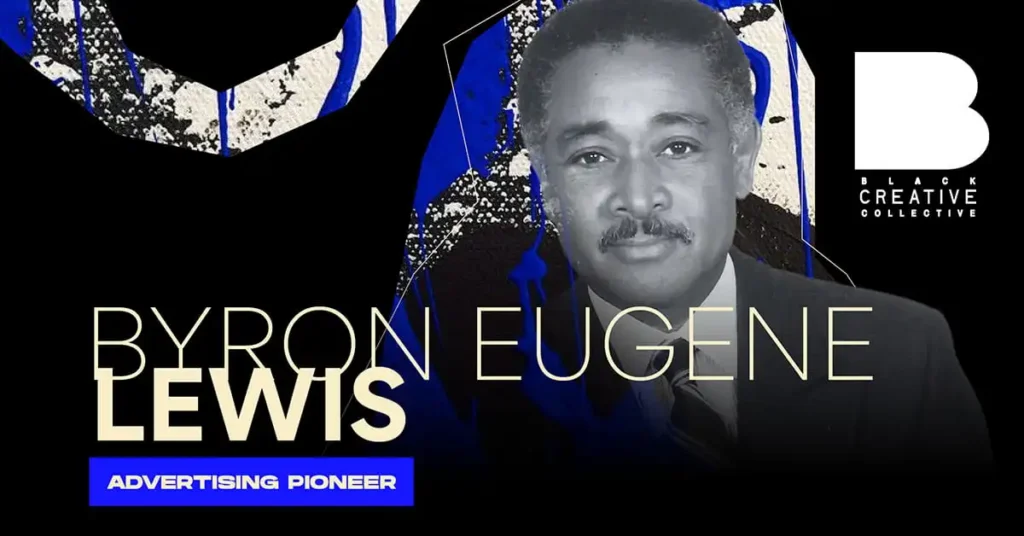
Byron Eugene Lewis Sr. founded UniWorld Group in 1969 with $250,000 in venture capital and a proposition that Madison Avenue had refused to acknowledge: Black consumers existed, they spent money, and they deserved advertising that reflected their lives. Over four decades, Lewis built UniWorld into the largest Black-owned advertising agency in the United States, generating $230 million in annual sales by 1999. His work didn’t just serve Black audiences—it fundamentally changed how American corporations understood the relationship between culture and commerce.
He Didn’t Just Build an Agency. He Built the Infrastructure That Made Black Consumers Visible.
Background: From Harlem’s Trenches to Madison Avenue
Byron Lewis was born on December 25, 1931, in Newark, New Jersey. His father, Thomas Eugene Lewis, ran a diversified small business—house painting, handyman work, seasonal farm labor—that gave the young Lewis an early education in how to generate income across multiple streams. His mother, Myrtle, worked as a domestic, a school cafeteria employee, and a Queens borough election worker for decades. That last role wasn’t incidental. She was actively connecting a Black community to civic institutions through data and participation—the same tools her son would later use to quantify Black buying power for Fortune 500 corporations.
The family settled in Jamaica, Queens, placing Lewis inside a middle-class Black enclave with active community institutions. His mentor, Rev. Charles Carrington of Brooks Memorial Methodist Church, involved him in theater, choir, and the Boy Scouts. The performative and persuasive training those environments provided laid groundwork for a career built on selling ideas to rooms that didn’t initially want to hear them.
Lewis earned his journalism degree from Long Island University in 1953—a year ahead of schedule, while working as a busboy. He was drafted immediately after graduation, serving in the first wave of fully integrated U.S. military units. His assignment to the ski patrol at Fort Richardson in Anchorage put him in terrain typically reserved for white elites. The pattern of navigating exclusionary spaces without asking permission would define his entire career.
After his discharge in 1955, Lewis worked as a social worker on the Lower East Side of Manhattan. This is the part of his biography that most profiles skip over. Working daily with Black, Latino, Italian, and Jewish families, Lewis developed a direct understanding of how different communities interacted with products and institutions—and how advertising systematically ignored most of them. He wasn’t studying consumer behavior in a classroom. He was watching it in the field.
The Harlem Years: Learning the Infrastructure
From 1961 to 1968, Lewis worked inside Harlem’s media scene, co-founding The Urbanite literary magazine in 1961 and later working as advertising director at Tuesday and Citizen Call. He described this period as “spending a decade in the trenches learning how to get Black magazines, newspapers, radio and television stations going.”
The Urbanite is worth understanding in detail. The magazine featured James Baldwin, Lorraine Hansberry, Langston Hughes, LeRoi Jones, and photography by Roy DeCarava. It was intellectually serious, beautifully produced, and backed by a $30,000 investment from songwriter Irving Burgie. It folded after three months.
The problem wasn’t the content. The problem was that major corporations had, as Lewis later put it, “never thought of Blacks as consumers.” White advertising revenue was simply unavailable for Black media, regardless of quality. That recognition—that Black publishing wasn’t failing because of Black audiences, but because white corporations refused to acknowledge those audiences existed—shaped everything Lewis built afterward.
At Tuesday, Lewis learned another structural lesson. Because traditional banks refused to extend loans against advertising contracts from Black publications, Lewis and colleagues relied on “Little Willie,” a Harlem numbers man who provided cash loans to keep operations running. The informal economy stepped in where the formal one refused to go. Lewis filed that lesson.
Founding UniWorld: Political Pressure as Seed Capital
By 1969, Lewis was ready to build something that could survive the structural barriers he’d mapped across a decade. He secured $250,000 in venture capital from two investment groups operating under late-1960s affirmative action mandates. Federal pressure on corporations and investment firms to diversify their portfolios created a narrow window. Lewis moved through it.
UniWorld Group launched as a full-service advertising agency with a specific thesis: Black and Brown consumers were an underserved market, not a niche market, and the corporations ignoring them were leaving money on the table. Lewis’s job was to translate Black life into economic data that white corporate leaders could act on.
Philosophy: The “Universal Minority Capacity”
Byron Lewis operated from a core belief that he eventually named the “universal minority capacity“—the idea that understanding how to reach marginalized audiences was not a specialty skill. It was the foundation of modern marketing.
His philosophy had three operational components:
Authentic representation over tokenism. Lewis refused to use the stereotypes that characterized mainstream advertising in the 1960s and 70s. His campaigns used what he called “authentic, colloquial voice” and “positive images of Black life.” This wasn’t a values statement—it was a strategic read. He understood that Black audiences could immediately identify when they were being addressed by someone who knew them versus someone who had done a cursory demographic analysis.
Cultural specificity as market intelligence. Lewis consistently turned cultural knowledge into business data. When pitching Avon, he didn’t appeal to their sense of social responsibility. He told them, “I wanna tell you who your best customers are.” Then he explained the “Avon Lady” phenomenon in Black neighborhoods—how she was a trusted community figure providing access to beauty products in areas where Jim Crow policies had blocked access to department stores. He reframed a social reality as a distribution network. Avon got the insight. Lewis got the account.
Content ownership as survival strategy. During the 1974 recession, as advertising budgets contracted, Lewis recognized that a service agency dependent on white corporate spending was structurally vulnerable. His solution was to manufacture distribution. He created Sounds of the City, a 15-minute daily radio soap opera about a Black family from the South navigating life in Chicago. He hired director Shauneille Perry, brought in Ossie Davis and Ruby Dee, and then sold Quaker Oats on sponsoring the entire production, generating campaigns for Aunt Jemima and Uncle Ben’s rice aimed at the show’s loyal audience. UniWorld earned its first million dollars in gross sales from the resulting media buys. The agency survived. Lewis had moved from service provider to content owner decades before that distinction became standard industry vocabulary.
Notable Campaigns
Shaft (1971) — MGM
UniWorld was hired to promote the Richard Roundtree film at a moment when Black-centered cinema was commercially uncertain. Lewis’s approach was to market Shaft as a cultural anthem, not a standard action film. He used Black Power rhetoric in radio spots aimed at urban Black markets, leaning into the film’s iconic Isaac Hayes soundtrack and the defiant energy of the character. The campaign helped establish the marketing blueprint for what became known as Blaxploitation cinema—demonstrating that Black audiences would show up for Black stories told on their own terms. It also proved that “word of mouth” from authentic communities could drive commercial outcomes without mainstream media buy-in.
Sounds of the City (1974) — Quaker Oats
A branded content program created as a direct response to the recession. Lewis produced a Black-centered radio serial, secured corporate sponsorship, and demonstrated that a Black-owned agency could function as a media creator, not just a media buyer. The program employed Black talent at a moment when mainstream television had little use for them and generated the revenue that kept UniWorld solvent. This was thirty years before “content marketing” became a recognizable industry term.
The 3 Musketeers Campaign — Mars
When Mars tasked UniWorld with marketing the 3 Musketeers candy bar, Lewis proposed making one of the swashbuckling characters Black. When pushed back on the idea, he deployed historical reclamation: Alexandre Dumas, who wrote the original 1844 novel, was of Afro-Caribbean descent. The campaign normalized Black presence within European heroic narratives—not in a “Black product” context, but in the aspirational general market. That distinction mattered.
Lincoln Navigator “Diapers” (1990s) — Ford
The first national automotive campaign aimed specifically at the urban Black middle class. By depicting Black parents in a luxury vehicle, the campaign directly challenged the prevailing narrative that Black consumer spending was limited to necessity or “vice” categories. Lewis repositioned the Black family as aspirational consumers in the luxury automotive market. Ford moved product. The industry took note.
Burger King
Lewis’s Burger King work included the tagline “We may not be No. 1, but we’re trying harder”—a direct challenge to McDonald’s dominance that delivered a documented 13% sales increase and defeated a Saatchi & Saatchi campaign for the same account. This demonstrated that UniWorld could compete—and win—against general-market agencies on major accounts.
What They Said
Lewis described his purpose plainly: he wanted Black consumers to see themselves as “equal consumers and equal citizens.” He understood that representation in advertising wasn’t a symbolic gesture—it was the mechanism by which economic power was acknowledged or withheld.
Those who worked with him documented his methodology. He trained over 1,000 employees, vendors, and freelancers over his career. UniWorld alumni went on to lead major marketing departments and found their own agencies. Monique Nelson, who purchased UniWorld from Lewis and serves as its current CEO and Chair, has expanded the agency’s client list to include Coca-Cola and The Home Depot. Kelsey Davis, founder of Gen-Z creator platform CLLCTVE, trained at UniWorld. Aundre Oldacre, founder of V-Mix, credits Lewis with his first career opportunity.
Herbert Kemp Jr., a former president of UniWorld and a pioneer in ethnic marketing, brought the Lewis methodology to firms including Ogilvy & Mather.
Why Lewis Matters Today
The structural problems Lewis identified in 1969 haven’t disappeared—they’ve evolved. Black-owned media still competes for advertising revenue against mainstream outlets whose audiences are smaller but whose cultural cache with ad buyers is larger. The case for reaching Black consumers still requires documentation that white audiences don’t need to provide. The informal networks that sustained Black creative businesses when formal capital was unavailable are now formalized as investment communities and accelerators.
What Lewis’s career demonstrates, practically, is that the response to structural exclusion isn’t waiting for inclusion—it’s building the infrastructure that makes exclusion economically irrational.
Three operational takeaways from his career:
1. Turn cultural knowledge into market intelligence. Lewis didn’t ask corporations to do the right thing. He showed them data. The Avon pitch worked because he had spent years observing Black consumer behavior at ground level. The knowledge you carry about your community is marketable intelligence—frame it that way.
2. Own the content, not just the service. Sounds of the City saved UniWorld because Lewis controlled the media vehicle, not just the advertising placed in it. If your agency or creative business is entirely dependent on what clients commission, you’re exposed to exactly the kind of budget contraction that nearly ended UniWorld in 1974. Owned content changes that equation.
3. Specificity beats universality. The Shaft campaign worked because it spoke to a specific community in a specific register. The 3 Musketeers campaign worked because it placed a specific community inside an aspirational narrative. Lewis consistently resisted the pressure to make Black-targeted work generic enough to be “universal.” Specificity was the strategy, not the limitation.
Lewis retired in 2012. His personal and business archives are now held at the Smithsonian Institution.
Resources to Explore His Legacy
- Smithsonian Institution Archives — Byron Lewis papers and UniWorld Group records
- American Black Film Festival (ABFF) — Founded by Lewis in 1997 (originally the Acapulco Black Film Festival): abff.com
- UniWorld Group — uniworldgroup.com
- The Clio Awards Archive — UniWorld campaign records
- Duke University’s John W. Hartman Center for Sales, Advertising & Marketing History — Archival resources for multicultural advertising history
Keep Building
Black Creative Collective is building a comprehensive archive of Black advertising history and the professionals who shaped it. If you’re researching multicultural marketing, looking to understand the strategic foundations of the industry, or building your own practice—our directory and community are here.
Browse the Black Creative Directory | Join the BCC Community Slack | Subscribe to our newsletter
Sources
- Lewis, Byron. Oral history and biographical documentation. Smithsonian Institution Archives.
- “UniWorld Group.” Agency History and Client Records. Smithsonian Institution.
- American Black Film Festival. “History.” abff.com/history
- Duke University Hartman Center. “Multicultural Advertising Resources.” library.duke.edu/hartman
- The Urbanite (1961). Publishing history documentation.
- UniWorld Group. Company records, 1969–2012.
- Nelson, Monique. Executive profiles and interviews. UniWorld Group.