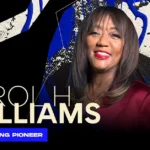
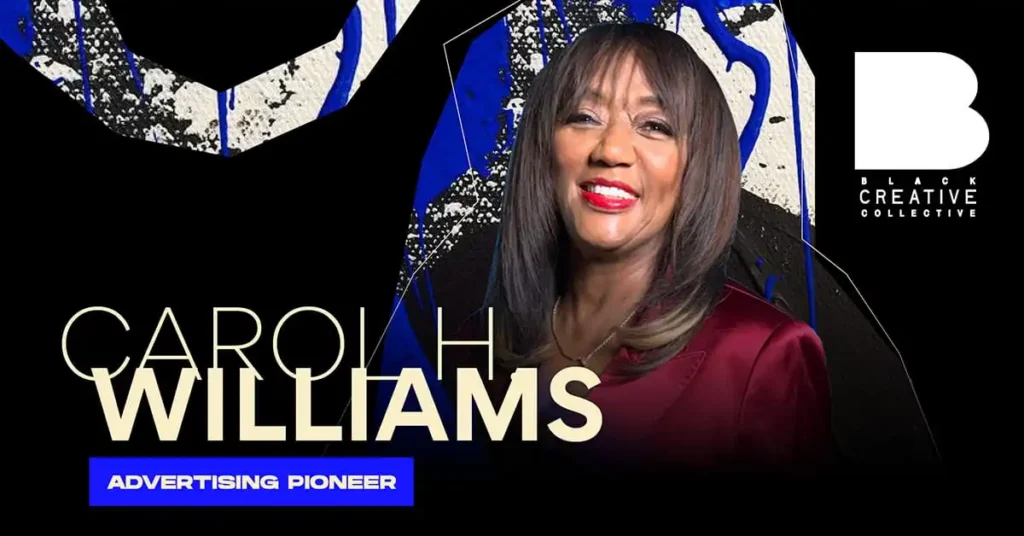
Summary: Carol H. Williams built one of the most enduring Black-owned advertising agencies in American history by refusing to let brands speak at Black consumers instead of to them. As the first African American woman to serve as Creative Director and Vice President at Leo Burnett, she pioneered a philosophy—”Whose Eyes”—that became an industry benchmark for cultural intelligence. Her Oakland-based firm, Carol H. Williams Advertising (CHWA), has remained 100% independent for nearly four decades, proving that cultural integrity and business performance are the same thing.
She Didn’t Just Break the Ceiling—She Built a New Floor
Carol H. Williams spent 13 years at Leo Burnett before founding her own shop. In that time, she moved Secret deodorant from ninth to first in its category, created Poppie Fresh as a fully autonomous character (not a sidekick), and became the only Black woman to hold Creative Director and VP titles at a major global agency. When she left to start CHWA in 1986, she wasn’t walking away from success. She was building infrastructure the industry couldn’t provide.
The agency she founded at her kitchen table in Oakland has since served the U.S. Army, General Motors, Kraft, Walt Disney, Gilead Sciences, Allstate, and Procter & Gamble. It is, by most accounts, the longest-running independent multicultural marketing shop in the country.
Background: From Chicago’s South Side to Leo Burnett’s 12th Floor
Williams was born October 11, 1949, and grew up in the Bronzeville and South Shore neighborhoods of Chicago’s South Side—what historians have called the “Black Metropolis.” The neighborhood was economically constrained by segregation but rich in Black-owned businesses, intellectual life, and institutional anchors like Grant Memorial AME Church, where Williams was immersed in a rhetorical tradition of “plain speaking”: complex ideas distilled into clear, direct language. That skill became the engine of her creative career.
She studied biology at Northwestern University, earning a B.S. in 1971 followed by an M.A. in Arts and Sciences. The scientific method—observe, hypothesize, test—became her strategic framework. She approached consumer behavior the same way she’d approached lab work: with rigor, curiosity, and evidence.
Her entry into advertising came through the Basic Advertising Class (BAC), a program co-sponsored by the 4A’s and Northwestern to open industry access to minorities. Founded by ad pioneer Bill Sharp, the BAC only ran five classes in its existence. Williams audited hers after missing enrollment and finished as the top achiever. That result got her through the door at Leo Burnett.
On her third day at Burnett, she was on the 12th floor—the section staffed predominantly by Black copywriters, which she later called “Chocolate City”—when she observed a white male colleague struggling with a campaign for Pillsbury’s Best flour. Williams offered a line drawn directly from her family’s Sunday morning kitchen rituals: “Nothing is quite as good as biscuits in the morning, it’s Pillsbury’s Best time of day.” It worked. That moment crystallized what would become her defining competitive advantage: cultural firsthand knowledge isn’t sentiment. It’s market intelligence.
Philosophy: “Whose Eyes Are You Looking Through?”
The central question Williams built her agency around is deceptively simple: Whose eyes are you looking through when you view the world?
That question is a diagnostic tool. It identifies whether a brand is communicating from the consumer’s actual experience or from a sanitized, externally imposed version of it. In the 1980s, most multicultural advertising consisted of “total market” campaigns—essentially white-centric narratives with Black actors inserted. Williams called it out as “absent from any cultural insight.”
Her philosophy had three operational components:
Authentic perspective over representation optics. Putting a Black face in an ad without cultural grounding isn’t multicultural marketing. It’s casting.
Evidence-based storytelling. Williams drew on real behavior, actual community rituals, and observed consumer values—not focus group archetypes.
Social responsibility as brand strategy. She built a policy of refusal into CHWA’s business model: no alcohol, no tobacco, no campaigns that degraded the communities she served. That wasn’t charity. It was brand equity protection.
This framework predated, and in some ways seeded, what the industry now calls “cultural intelligence.” Williams was practicing it as standard operating procedure in 1986.
Notable Campaigns
Secret Deodorant — “Strong Enough for a Man, But Made for a Woman” At Leo Burnett, Williams inherited the Secret account when the brand ranked ninth in its category. The prevailing creative strategy relied on imagery of women as delicate, domestic, and barely physical. Williams built the campaign around a different observation: women work hard, carry weight, and sweat—and they deserve a product that actually performs for them. The campaign connected product efficacy to the physical reality of women’s lives. Secret moved to number one. The tagline became one of the most recognized in advertising history.
Poppie Fresh — Pillsbury When Williams developed Poppie Fresh as the female companion to the Pillsbury Doughboy, she set a condition: Poppie would not be poked in the stomach, the Doughboy’s signature interaction. Her argument was direct. A large hand poking a small female-coded character without consent wasn’t a playful brand moment—it was a normalized image of gendered vulnerability. Pillsbury agreed. Poppie Fresh became an autonomous character with her own identity, not a prop.
U.S. Army Recruitment Campaign CHWA shifted Army messaging from pure recruitment to career and legacy—specifically addressing the parents of potential recruits. Williams recognized that Black families don’t just want to know if their child has a job. They want to know if the institution will respect them. The campaign spoke to parental favorability and long-term security, targeting the actual decision-making environment rather than the individual enlistee.
2020 U.S. Census — Multicultural Outreach CHWA applied the “Whose Eyes” framework to a civic communication challenge: reaching “hard-to-count” populations for the 2020 Census. The work wasn’t just creative. It was civic infrastructure. Accurate Census counts determine federal funding distribution and political representation. Williams treated the campaign as what it was—a systems-level intervention.
“My Black Is Beautiful” — Procter & Gamble This initiative moved beyond standard beauty advertising by refusing to center narrow, Eurocentric aesthetics as the default aspiration. The campaign affirmed the cultural specificity and diversity within the Black consumer market, positioning P&G as a brand that understood the community rather than one broadcasting to it.
What She Said—and How the Industry Describes Her
On the “Whose Eyes” framework: “Whose eyes are you looking through when you view the world?”
On the Secret campaign’s creative premise: She wanted women who were “hard-working… lugging groceries, lugging babies, lugging laundry” to see themselves in advertising—not the sanitized version the men in the room were producing.
On independence: By refusing equity partnerships with holding companies, Williams ensured that cultural representation decisions stayed inside the agency—not with external stakeholders whose incentives didn’t align with community interests.
Industry peers and historians have described her as the “turnaround queen” for her consistent ability to transform underperforming brand accounts into category leaders. The American Advertising Federation recognized her as the first Black woman inducted into the AAF Advertising Hall of Fame. That distinction matters not as decoration but as documented validation that multicultural creative work meets the highest industry standards—a claim the industry had long deferred.
Why She Matters Today: Practical Takeaways for Black Creatives and Marketers
- Cultural insight is a product, not a bonus. Williams built a business by packaging what mainstream agencies couldn’t produce. If you have firsthand knowledge of a consumer segment, that knowledge has market value. The question is whether you’re structuring your work to capture it.
- Independence is a strategic position, not just a preference. Every equity partnership Williams declined was also a decision to keep “policy of refusal” intact. When a holding company owns your agency, they own your decisions. Independence has costs. It also has compounding advantages.
- Refusal is a form of brand strategy. Williams turned down high-billing categories—alcohol, tobacco—that conflicted with community values. That refusal built credibility that no campaign could buy. For marketers advising clients today, knowing what a brand shouldn’t do is as valuable as knowing what it should.
- The “Whose Eyes” audit is a transferable tool. Before any campaign brief, ask: whose perspective is this built from? Whose behavioral patterns, rituals, and values are embedded in the strategy? If the answer is “the client’s internal assumptions,” the brief needs more work.
- Mentorship infrastructure matters as much as individual achievement. Lincoln Stephens co-founded the Marcus Graham Project while working at CHWA in Chicago. The MGP has since become a national pipeline for multicultural talent in advertising. Williams’ influence multiplies through those structures—not just her own résumé.
Resources to Explore Her Legacy
- AAF Advertising Hall of Fame: Carol H. Williams inductee profile — aaf.org
- Marcus Graham Project: Direct descendant of CHWA’s mentorship culture — marcusgrahamproject.org
- Carol H. Williams Advertising: Agency work and philosophy — chwainc.com
- Mannion v. Coors Brewing Company (2005): Legal case documenting CHWA’s work and the protectible elements of photography in advertising
- “Discover the Unexpected” Fellowship with Chevrolet: CHWA’s modern pipeline program for aspiring journalists of color
Keep Building
BCC profiles Black advertising pioneers because understanding this history makes you a stronger strategist—not because the past is interesting, but because the frameworks hold. If you’re working on campaigns, pitching clients, or building your own shop, Williams’ “Whose Eyes” question belongs in your toolkit.
Explore more trailblazer profiles in the BCC archive
Join the BCC community Slack — where Black marketers share salary wins, client referrals, and campaign breakdowns.
Subscribe to the BCC newsletter for weekly industry analysis built for practitioners, not observers.
Sources
- Life history analysis of Carol H. Williams (primary research document)
- AAF Advertising Hall of Fame records
- Mannion v. Coors Brewing Company, 377 F. Supp. 2d 444 (S.D.N.Y. 2005)
- Carol H. Williams Advertising agency history and case studies — chwainc.com
- Marcus Graham Project organizational history — marcusgrahamproject.org
- Basic Advertising Class (BAC) historical records, 4A’s / Northwestern University
- Procter & Gamble “My Black Is Beautiful” campaign documentation
- U.S. Census Bureau 2020 multicultural outreach program records